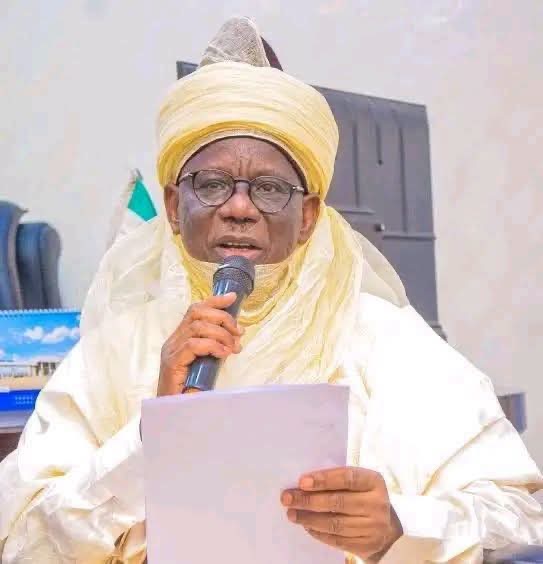
Wazirin Katsina, Sen Ida : Why Traditional Thrones Still Matter



FROM CALIPHATE TO CONSTITUTION: Why Traditional Thrones Still Matter…
By Sen. Ibrahim M. Ida, CON, Ph.D., Wazirin Katsina
In every village in Northern Nigeria, two authorities exist. One is elected and sits in a local government secretariat. The other is inherited and sits in a palace. One wields defined executive power under the 1999 Constitution; the other holds no defined federal role under that Constitution, though it is recognized by state chieftaincy laws. Yet the second often commands deeper legitimacy at the grassroots.
That paradox lies at the heart of Nigeria’s security and governance debate. As banditry, kidnapping, and farmer-herder clashes overwhelm formal structures, we are forced to confront a question we have evaded since 1976: Can we run a modern state while keeping its most trusted grassroots institution outside the federal Constitution?
From Empire to Native Authority
At the turn of the 20th century, Northern Nigeria was dominated by the Sokoto Caliphate. Founded in 1804 by Shehu Usman dan Fodio, it stood at its peak as one of the largest organized states in West Africa, alongside the Kanem-Borno Empire. These were not mere chiefdoms; they possessed sophisticated taxation, judicial, and administrative systems rooted in Islamic jurisprudence.
British conquest ended that sovereignty. Kano fell in February 1903, and Sokoto followed on 15 March 1903. Sultan Muhammadu Attahiru I chose hijra over submission, a journey that ended with his death at the Battle of Burmi on 27 July 1903 in present-day Gombe. The British subsequently installed Attahiru II as Sultan under curtailed authority.
With few administrative officers on the ground, Frederick Lugard adopted Indirect Rule. Emirs retained their palaces, Dogarai police, and Native Courts, but surrendered sovereignty and foreign affairs. Paradoxically, this made them more autocratic locally, as they became accountable only to the British Resident rather than to their traditional councils.
The Systematic Erosion of Power, but Not of Influence
The erosion of traditional authority began not with the military, but with educated elites. In August 1950, Malam Abubakar Tafawa Balewa, then representing Bauchi Native Authority in the Northern House of Assembly, moved his famous motion calling for an inquiry into the Sole Native Authority system. That motion triggered reforms replacing sole autocracy with the Chief-in-Council model.
At independence, the 1960 and 1963 Constitutions preserved a formal role for traditional institutions through bicameral regional legislatures featuring Houses of Chiefs. Emirs operated as constitutional monarchs with genuine influence.
Military rule dismantled that arrangement. General Ironsi’s 1966 Unitary Decree, General Gowon’s 1967 state creation, and—most decisively—the 1976 Local Government Reform under the Murtala/Obasanjo regime abolished the Native Authority system. Emirs lost their police, prisons, and courts, while Traditional Councils were reduced to advisory bodies subordinate to elected local councils.
The Sultan of Sokoto and the National Council of Traditional Rulers have consistently argued that this created a vacuum in grassroots intelligence that has fueled today’s insecurity. It is a view shared by many security practitioners, even while acknowledging that insecurity has multiple roots.
The Dasuki Interlude and the Funding Trap
In May 1984, the Buhari military regime inaugurated a 20-man Committee on Local Government chaired by Alhaji Ibrahim Dasuki, a prince who later became the 18th Sultan of Sokoto. Its mandate included evolving an appropriate role for traditional authorities.
Dasuki occupies a fascinating place in this history: he helped draft the 1976 guidelines that stripped power from Emirs, and then chaired the 1984 review meant to rationalize the new system. As one analyst aptly observed, his committee “took power from the aristocracy and handed it to the children of the Talakawa.”
The Committee reaffirmed that traditional rulers should remain insulated from partisan politics and focus on advisory roles in peacekeeping and community mobilization. It also recommended abolishing State Ministries of Local Government and disbursing federal allocations directly to local councils—a reform later implemented by the Babangida administration.
However, the financial dependency we see today stemmed from the implementation of the Report and its Government White Paper, which mandated local councils to fund traditional rulers out of their statutory allocations. This—rather than the core recommendation on local autonomy—is what scholars identify as the origin of the current trap.
As Speaker Tajudeen Abbas has noted, true financial autonomy has been ignored. For as long as Emirs depend on local councils and Governors for their salaries and palace upkeep, any constitutional role will remain purely ceremonial.
This vulnerability explains why a Governor can today depose a first-class Emir with a press release. There is no federal law shielding the institution, as the 1999 Constitution—unlike its predecessors—assigns it no defined federal status.
The Push for change started 2024 Continues
From 2024,the National Council of Traditional Rulers (NCTR) resolved to campaign for constitutional recognition. That effort culminated in House Bill 203—currently at the Committee Stage in the 10th National Assembly as of November 2026—sponsored by Hon. Ikenga Ugochinyere and Hon. Ibrahim Al-Mustapha Aliyu. The Bill seeks to alter the Constitution by inserting new provisions after Section 220 (which currently governs compulsory military service), introducing proposed Sections 220A onward to codify roles for traditional rulers.
A companion bill in the Senate is being sponsored by Senator Simon Lalong.
The Speaker of the House of Representatives, Rt. Hon. Tajudeen Abbas, has disclosed that the proposals in the Red and Green Chambers envision a three-tier structure: a National Council of Traditional Rulers to advise the President, State Councils to advise Governors on customary law and peacebuilding, and Local Government Traditional Councils focused on security and community development. The framework draws heavily from the unimplemented Section 8 of the 1989 Draft Constitution.
What is being proposed is hardly alien. Ghana, Uganda, and South Africa all maintain constitutionally recognized Houses of Chiefs.
Two international models operating – one within the continent of Africa, and the other in Asia, are particularly instructive. In Morocco, Article 41 of the 2011 Constitution recognizes the King as Commander of the Faithful, presiding over the Higher Council of Ulema—the sole body authorized to issue official religious opinions. In Malaysia, the Conference of Rulers, under Articles 32, 38, and 153, elects the King on a rotational basis and must be consulted on matters affecting Islam and Malay custom. Both demonstrate how traditional institutions can be constitutionally anchored with defined, circumscribed functions, without wielding executive power.
Naturally, points of contention within the proposes Nigerian legislation remain. One of these is the proposal to make the Sultan of Sokoto and the Ooni of Ife permanent co-chairmen of the proposed National Council has drawn opposition from the Benin throne, which favors rotation. These are political questions that will be ironed out in the final legislation.
The Soft Power Still Works
Why does this matter? Because even without constitutional backing, traditional networks continue to deliver results. Emirs, Hakimai, and Dagatai mediate countless land and family disputes daily. According to police and development agency assessments, they serve as indispensable frontline partners in intelligence gathering, polio eradication, and deradicalization, and remain among the most trusted interlocutors at the community level.
The law may define authority in Abuja, but legitimacy in many rural communities still flows through the palace.
Conclusion
From the Caliphate founded in 1804 to the ceremonial councils of the Fourth Republic, our traditional institutions have endured by adapting. The question before us now is not whether they remain relevant, but whether the Constitution will finally catch up with reality—granting them a defined, funded, and protected advisory role, as Morocco and Malaysia have done, rather than leaving them as ornaments at the mercy of the politics of the day.
